TL;DR
- Holds 59.9% of the entire CMS market, more than every competitor combined
- Security is the real risk: 11,334 new vulnerabilities discovered in 2025, 96% from plugins, not core
- WordPress 7.0 (May 2026) brings real-time collaboration and native AI integration via the Abilities API
- Still the top choice for content-driven, SEO-focused sites — but only if properly maintained
Every second, someone publishes new content on a WordPress website. By the time you finish reading this sentence, thousands more pages have gone live, from personal blogs and small business sites to major news outlets and global eCommerce stores. That scale is not accidental.
According to W3Techs WordPress powers approximately 43% of all websites on the internet as of 2026. Among websites using a known content management system, that share climbs above 60%, meaning WordPress is used more than all other CMS platforms combined. Its nearest rival, Shopify, sits at around 5%.
~43%
of all websites globally
Source: W3Techs, 2026
60%+
of the CMS market
Source: W3Techs, 2026
9×
larger than Shopify
Source: W3Techs, 2026
23 yrs
and still growing
Since May 2003
- WordPress 43%
- Shopify 5%
- Wix 4%
- Squarespace 2%
- All others ~5%
Note: remaining ~41% are custom-built or no-CMS sites
What is WordPress Market Dominance and Why Does it Matter?
“Market dominance” sounds like a corporate buzzword. But in the context of a website platform, it has a very practical meaning, and it directly affects the decisions you make when building or managing a site online.
What exactly is a CMS and why is WordPress one?
A content management system (CMS) authoritative source, opens new tab is software that lets you create, edit, and publish content on a website without writing code for every change. Think of it as the control room behind your website — where pages get written, images get uploaded, and new posts go live.
WordPress is the world’s most widely used CMS. It started in 2003 as a blogging tool built by Matt Mullenweg and Mike Little. Over the following two decades it evolved into a full platform capable of running anything from a personal portfolio to a global news outlet or an enterprise eCommerce store.
What makes WordPress a CMS, and not just a website builder is that it separates content from presentation. Your text, images, and data live independently of how your site looks. That means you can redesign your site completely without touching a single word of content. For businesses publishing regularly, this distinction is critical.
Why does platform dominance matter for your website?
- More developers know it — hiring help is easier and more affordable
- More plugins exist — almost any feature you need has already been built
- More themes are available — design choices are virtually unlimited
- More tutorials exist — solving problems rarely requires paid support
- More hosting is optimised for it — performance and reliability improve across the board
This is why WordPress’s dominance is not just a number to quote in a report. It is the reason that choosing WordPress in 2026 still carries less risk, and more long-term flexibility than almost any alternative. Building on the most-used platform means you are never building alone.
WordPress market dominance = the platform’s share of all websites globally (~43%) and of the CMS market specifically (~62%). It reflects not just popularity, but the depth and self-sustaining nature of the WordPress ecosystem, developers, plugins, themes, hosting, and community that makes it the rational default for most website projects.
WordPress By the Numbers: 2026 Market Share Data
Numbers are only credible when you know where they come from. Every statistic in this section is drawn from W3Techs – cite directly, the most widely referenced source for CMS adoption data, used by Google, Automattic, and major tech publications worldwide. W3Techs tracks what it calls “the relevant web”, sites with real content and traffic, not parked domains or empty pages. That distinction matters, and we will come back to it.
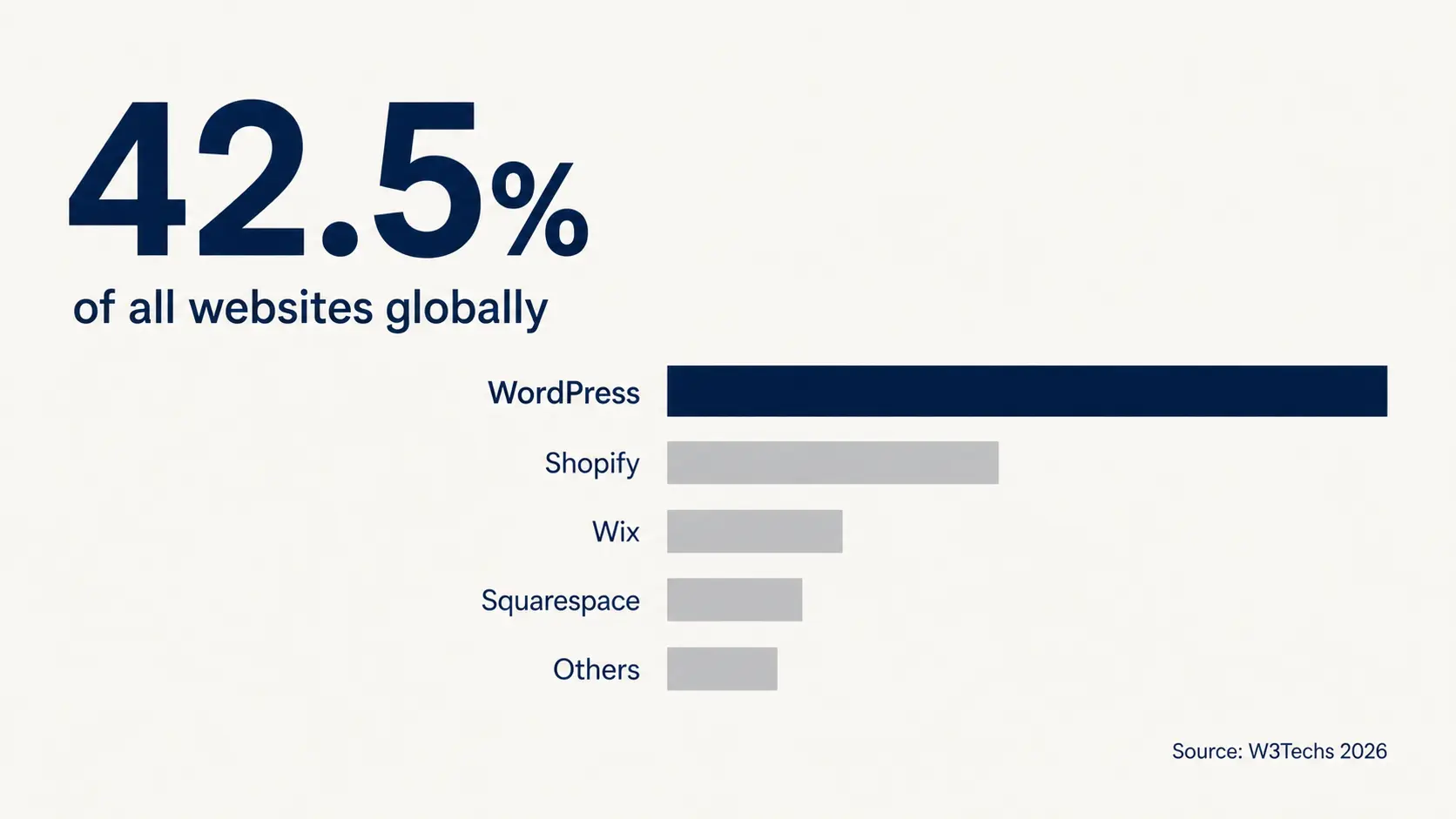
42.5%
of all websites globally run on WordPress
W3Techs, April 2026
59.9%
of websites using a known CMS
W3Techs, April 2026
37.5M+
active live WordPress websites
BuiltWith, 2026
605M
total sites ever built on WordPress
NetCraft + W3Techs, 2026
How much of the web does WordPress power in 2026?
As of April 2026, WordPress powers approximately 42.5% of all websites on the internet, according to W3Techs. Among websites using a detectable content management system, that share rises to 59.9% meaning WordPress is used on more sites than every other CMS platform put together.
Its nearest competitor, Shopify, holds around 5.1% of all websites. WordPress has roughly nine times the reach of the second-largest platform. Wix follows at 4.2%, Squarespace at 2.4%, with Joomla and Drupal once considered serious competitors now sitting below 1.5% each.
- WordPress 42.5%
- Shopify 5.1%
- Wix 4.2%
- Squarespace 2.4%
- Joomla 1.3%
- Drupal 0.7%
How has WordPress market share grown over time?
WordPress has more than tripled its market share in 15 years growing from 13.1% in 2011 to 42.5% in April 2026. That is consistent, sustained growth across more than a decade. But the trend line tells a more nuanced story than the headline figure suggests.
- 2011 13.1%
- 2014 21%
- 2017 27.3%
- 2019 32%
- 2021 39.5%
- 2023 43%
- 2026 42.5%
A note on how the data is measured and why it matters
| SOURCE | WHAT IT MEASURES | WORDPRESS FIGURE |
| W3Techs | Share of “relevant web” – sites with real content and traffic | 42.5% of all sites |
| BuiltWith | Actively visited web properties only | ~37.5M active sites |
| NetCraft | All hostnames, including parked domains | ~605M total sites |
How many websites use WordPress in 2026? According to W3Techs, WordPress powers approximately 42.5% of all websites globally as of April 2026 around 37.5 million active sites. Among websites using a known CMS, WordPress holds a 59.9% share, making it more widely used than all other content management systems combined.
WordPress vs. The Competition: How it Compares in 2026
Market share tells you who is winning. A head-to-head comparison tells you why, and whether the winner is actually right for your situation. WordPress dominates in the numbers, but its competitors are not irrelevant. Shopify, Wix, Squarespace, and modern headless frameworks each occupy a real niche. Understanding where those niches begin and end is the most useful thing this section can give you.
- WordPress 42.5%
- Shopify 5.1%
- Wix 4.2%
- Squarespace 2.4%
- Joomla 1.3%
- Drupal 0.7%
- Webflow 0.8%
WordPress vs. Shopify
WordPress with WooCommerce takes more setup, but gives you complete ownership and far greater flexibility. Among the top 10,000 websites by traffic, WordPress accounts for roughly 58% of CMS usage — while Shopify is nearly absent at that level. That single data point dismantles the idea that WordPress is only for small sites.
WordPress vs. Wix and Squarespace
WordPress vs. headless CMS and modern frameworks
WordPress can also run headless, using its REST API or WPGraphQL to feed content into a custom frontend but that requires custom WordPress development expertise that most site owners do not have in-house. For developer-led projects where performance is critical, headless is a legitimate alternative. For most businesses running content-driven websites, the overhead is not worth it.
| CRITERIA | WORDPRESS | SHOPIFY | WIX | HEADLESS CMS |
| Market share | 42.5% | 5.1% | 4.2% | <1% |
| Plugins / apps | 59,000+ | ~12,300 | ~600 | Varies |
| Content ownership | Full | Partial | Locked in | Full |
| Ease of setup | Moderate | Easy | Easy | Complex |
| eCommerce | Via WooCommerce | Native | Basic | Custom |
| Performance | ~3.4s avg | ~2.1s avg | ~2.3s avg | <1s avg |
| SEO control | Full | Good | Limited | Full |
| Cost (entry) | Free + hosting | $29/mo+ | $17/mo+ | Varies |
WordPress vs competitors in 2026: WordPress holds 42.5% of all websites nearly nine times more than Shopify (5.1%) and ten times more than Wix (4.2%). Shopify wins for pure eCommerce beginners. Wix and Squarespace win for fast, low-maintenance launches. Headless CMS wins on performance for developer-led projects. For everything else content-driven sites, business websites, and anything that needs SEO control and full ownership – WordPress remains the dominant and most flexible choice.
6 Reasons WordPress Still Dominates the Web
Market share does not hold at 42.5% for two decades by accident. Competing platforms have had billions in venture funding, aggressive marketing, and genuine product improvements yet none has come close to unseating WordPress. The reasons are structural, not sentimental. Here is what actually keeps WordPress on top.
It is open source and that changes everything
WordPress is free to use, modify, and distribute. There are no licensing fees, no vendor lock-in, and no pricing model that changes the day a company goes public. The core software is maintained by a global community of thousands of developers – not a single company with shareholders to answer to.
That open-source foundation means your costs are hosting and plugins, not platform fees. A comparable proprietary CMS at enterprise level can cost tens of thousands per year in licensing. WordPress charges nothing for the software itself. For businesses of every size, that changes the economics of building and owning a website entirely.
An ecosystem no competitor has replicated
WordPress has 59,000+ free plugins in its official directory and thousands more premium options. Shopify has around 12,300 apps. Wix has roughly 600. Squarespace has between 31 and 45 extensions. The gap is not marginal it is an order of magnitude.
Need SEO tools? Yoast SEO has over 13 million active installs. Need forms? WPForms is installed on more than 6 million sites. Need eCommerce? WooCommerce powers over 34% of all online stores globally. Whatever your website needs to do, someone has almost certainly already built the plugin for it and the plugin has been tested by millions of sites before yours.
Built for SEO from day one
WordPress was designed as a publishing platform before SEO was even a mainstream concern and that original architecture turns out to be remarkably well-suited for search. Clean permalink structures, logical content hierarchy, automatic XML sitemaps, and full control over metadata, schema markup, and canonical tags are all standard.
Critically, Google does not rank platforms — it ranks pages. But WordPress makes implementing every ranking factor Google evaluates significantly easier than its competitors. Full control over crawlability, internal linking, site architecture, and page speed optimisation means a well-built WordPress site can outperform any alternative when the fundamentals are done right.
It scales from a blog to a global enterprise
When businesses need to grow their site without rebuilding it, WordPress maintenance and development can scale the platform to match rather than forcing a costly migration to an entirely new system.
The developer talent pool is unmatched
Because WordPress powers 42.5% of the web, it is the platform most developers learn first and the one most agencies are built around. Finding a developer who knows WordPress is vastly easier and less expensive than finding one who specialises in a proprietary alternative.
“WordPress is not just a platform it is infrastructure. The market share matters because it determines how many developers, tools, and integrations exist to support your site for the next decade. That depth of ecosystem is what no competitor has been able to replicate.”
Matt Mullenweg, Co-founder, WordPress & CEO, Automattic
You own everything — no platform lock-in
For businesses investing seriously in content, SEO, and long-term digital growth, that ownership is not a minor convenience it is a foundational strategic decision. Whether you manage it yourself or work with a WordPress support partner, the asset you are building belongs to you.
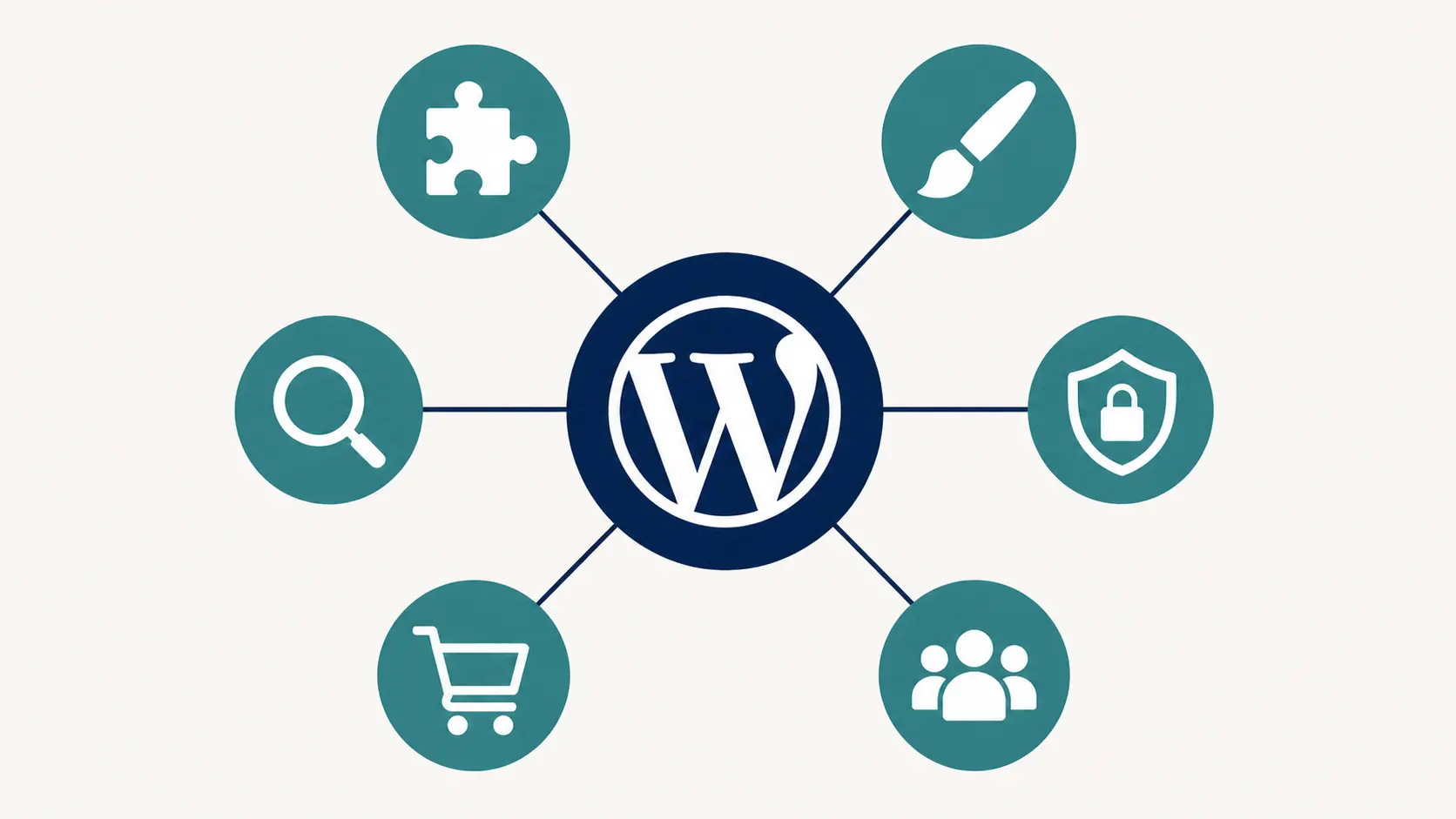
Why does WordPress dominate the web? Six structural reasons: it is free and open source, it has an unmatched plugin ecosystem (59,000+), it is built for SEO, it scales from small sites to global enterprises, it has the deepest developer talent pool of any CMS, and it gives users full ownership of their content and data with no platform lock-in.
WooCommerce: WordPress Dominance Extends to eCommerce
WordPress does not just power content websites. Through WooCommerce its free, open-source eCommerce plugin, it powers a significant share of global online retail too. WooCommerce was first released in 2011 and joined Automattic in 2015. By 2026 it has become the most widely used eCommerce platform in the world by total store count, and WordPress’s dominance story cannot be told without it.
4.5M+
StoreLeads, Q1 2026
33.4%
StoreLeads, 2026
$30–35B
Multiple sources, 2026
211M+
WordPress.org, 2026
WooCommerce vs Shopify: the honest comparison
The most common question is whether WooCommerce or Shopify is bigger. The answer depends entirely on how you measure. By total store count, WooCommerce leads globally with a 33.4% share, compared to Shopify at 19.6%. Among high-traffic sites, the picture flips: Shopify holds 28.8% of the top 1 million eCommerce websites, while WooCommerce sits at 18.2%.
- WooCommerce 33.4%
- Shopify 19.6%
- Custom carts 13.5%
- Wix Stores 7.4%
- Magento 3.2%
Why businesses choose WooCommerce over Shopify
The core advantage of WooCommerce is the same as WordPress itself: zero platform fees, full ownership, and unlimited flexibility. Shopify charges $29–$299 per month in base fees, plus transaction fees if you don’t use Shopify Payments. WooCommerce charges nothing for the software. Your costs are hosting, any premium plugins you choose, and WooCommerce developmen if you need custom functionality.
| CRITERIA | WOOCOMMERCE | SHOPIFY |
| Platform fee | $0 | $29–$299/mo |
| Transaction fees | None | 0.5–2% (non-Shopify Pay) |
| Content + commerce | Fully integrated | Limited blog |
| Data ownership | Full | Partial |
| Setup complexity | Moderate | Easy |
| Performance (default) | ~3.7s avg | ~2.0s avg |
| Extensions / plugins | 59,000+ | ~12,300 |
| Best for | Content-led stores, SMBs, EU markets | High-volume brands, beginners |
One nuance worth flagging: WooCommerce’s default performance an average page load of around 3.7 seconds — is slower than Shopify out of the box. But this is a hosting and configuration issue, not a platform limitation. A properly hosted and optimised WooCommerce store can match or exceed Shopify’s performance. The difference is that Shopify optimises that for you automatically, while WooCommerce gives you the tools to do it yourself or work with someone who can.
WooCommerce market share in 2026: WooCommerce powers 33.4% of all eCommerce websites globally, more than any other platform by store count. It runs over 4.5 million active stores across 200+ countries and processes an estimated $30–35 billion in annual sales. It leads by total adoption; Shopify leads among high-traffic enterprise stores.
The Real Challenges WordPress Faces in 2026

Security: plugins are the weak link
| YEAR | NEW VULNERABILITIES DISCOVERED | TREND |
| 2022 | 4,528 | Baseline |
| 2023 | 5,948 | +31% |
| 2024 | 7,966 | +34% |
| 2025 |
11,334 | +42% — 31 new flaws/day |
96% of WordPress vulnerabilities originate in plugins and themes, not the WordPress core itself. The core is actively maintained and regularly patched. The risk sits in the ecosystem around it. In 2025, 43% of discovered vulnerabilities could be exploited without authentication, meaning no login credentials required for an attacker to compromise a site.
THE REAL RISK IN PLAIN TERMS
The average WordPress site faces 172 attack attempts per day in 2026. Vulnerabilities are now being exploited within 5 hours of public disclosure. A site running outdated plugins even briefly is an active target, not a theoretical one.
This is precisely why professional WordPress maintenance has shifted from a nice-to-have to a genuine business requirement. Manually monitoring and updating every plugin across a live site, at the speed vulnerabilities now emerge, is not a realistic strategy for most businesses. And when a breach does occur, the cost of WordPress malware removal — in both money and lost rankings, far exceeds the cost of prevention.
Performance: the default gap is real
The Automattic vs WP Engine dispute — and what it means
AI-powered site builders — a genuine threat or overhyped?
WordPress challenges in 2026: Security is the most pressing — 11,334 vulnerabilities were discovered in 2025 alone, with 96% originating from plugins. Performance defaults lag behind modern frameworks but are solvable with proper configuration. The Automattic vs WP Engine dispute introduced governance uncertainty. AI site builders compete at the low end of the market but do not threaten WordPress’s position for serious business or content-driven websites.
What’s next: WordPress 7.0, AI, and the Road Ahead
WordPress is not standing still. After a turbulent 2025 slowed by legal disputes and contributor uncertainty, the platform has returned to momentum in 2026. WordPress 7.0, scheduled for release on 20 May 2026, is the most significant update since the Block Editor launched in 2018. It marks the completion of Gutenberg Phase 3, and it arrives with three changes that matter most for business owners and content teams.
Real-time collaboration
Native AI client
Admin redesign
Real-time collaboration coming to WordPress core
WordPress 7.0 and native AI integration
The 2026 WordPress release roadmap
WordPress 6.9 “Gene”
WordPress 7.0
WordPress 7.1
WordPress 7.2
For businesses running WordPress, the practical implication of this roadmap is straightforward: this is not a platform winding down. It is a platform that paused to clear debt and resolve governance issues, and is now accelerating. If your site needs a WordPress development review ahead of the 7.0 update, particularly around plugin compatibility and PHP version requirements – now is the right time to do it.
What is new in WordPress in 2026? WordPress 7.0 (releasing 20 May 2026) delivers three major changes: real-time collaborative editing built into core, a native AI client via the Abilities API that connects to any AI provider, and a full admin interface redesign. It completes Gutenberg Phase 3, eight years in development, and signals a platform accelerating, not declining.
Is WordPress Still Worth it in 2026?
When WordPress is the right choice
WordPress is a strong fit when you:
- Need long-term SEO and content investment
- Want full ownership of your data and site
- Run or plan an eCommerce store with complex needs
- Require custom features or integrations
- Have a team managing content regularly
- Want to avoid monthly platform subscription fees
- Need to scale without rebuilding from scratch
WordPress may not be ideal when you:
- Need a simple 3–5 page site online today
- Have no technical resource or support partner
- Run a pure product store with no content needs
- Cannot commit to regular maintenance and updates
- Need enterprise performance with a developer team
The one condition that changes everything
That is the actual choice in 2026. Not WordPress vs Shopify or WordPress vs Wix. It is managed WordPress vs unmanaged WordPress. The platform’s dominance is built on businesses that invested in it properly — with good WordPress hosting, consistent maintenance, and expert development when the platform needed to grow.
Conclusion: WordPress dominance is earned, not inherited
FAQ
How many websites use WordPress in 2026?
According to W3Techs, approximately 42.5% of all websites globally run on WordPress as of April 2026 around 37.5 million active sites. Over its lifetime, more than 605 million websites have been built on the platform.
What percentage of websites use WordPress?
WordPress powers 42.5% of all websites and 59.9% of websites using a known CMS, according to W3Techs data from April 2026. That means WordPress is used on more websites than all other content management systems combined.
Is WordPress losing market share?
Who are WordPress's biggest competitors?
By market share: Shopify (5.1%), Wix (4.2%), and Squarespace (2.4%) are the closest rivals. For eCommerce specifically, Shopify competes most directly. For developer-led projects, headless CMS platforms like Contentful and Sanity are growing alternatives. None is close to WordPress’s overall reach.
Is WordPress good for SEO in 2026?
Yes, WordPress remains one of the strongest platforms for SEO. It gives you full control over site architecture, metadata, schema markup, internal linking, and crawlability. Combined with plugins like Yoast SEO or Rank Math, a well-built WordPress site can outperform any competing platform when the fundamentals are done correctly.