TL;DR
Index WordPress Website for ChatGPT Search
By optimizing for ChatGPT, you can connect with more people who use AI for their searches.
This guide will show you how to get your WordPress site ready for ChatGPT. It will help you stay up-to-date with the latest trends. If you want the bigger picture on how AI search is reshaping visibility beyond just ChatGPT, check out our guide on Beyond the Blue Link: How to Win at AI Search.
Why Indexing Your WordPress Website for ChatGPT Search Matters
The Rise of AI in Search
Artificial intelligence has changed how we search for information. Unlike old search engines, ChatGPT and similar AI tools give answers that feel like a conversation, complete with links to the sources they pull from.
Benefits of ChatGPT Search Visibility
- Higher Engagement: Users get direct answers, which makes them more likely to interact with your site.
- Improved Reach: ChatGPT indexing lets you reach people who don’t use traditional search engines.
- Future-Proofing: By adopting AI early, you get a head start over your competitors.
Note: OpenAI updated its crawler documentation in late 2025, clarifying that blocking OAI-SearchBot doesn’t automatically exclude a site from ChatGPT’s search results the way it once implied. Still, allowing the crawler remains the most reliable way to ensure your content is actually seen and cited.
Understanding ChatGPT Search
What Is ChatGPT Search?
How ChatGPT Crawls and Indexes Websites
- Readable Content: AI prefers clear, concise, and well-structured articles.
- Schema Markup: Helps AI understand the context of your content.
- Regular Updates: Updated content is prioritized for accuracy.
Steps to Index WordPress Website for ChatGPT Search
1. Prepare Your Website for AI Indexing
- Mobile-Friendly Design: Use responsive themes to enhance user experience.
- Fast Load Time: Optimize images and leverage caching tools to improve performance.
- Updated Plugins and Themes: Keep WordPress updated for compatibility.
2. Use Tools and Plugins to Optimize WordPress for ChatGPT Search
- Yoast SEO: Optimize meta descriptions and content readability.
- Rank Math: Focuses on schema markup to improve AI compatibility.
- ChatGPT Indexing Tools: Emerging plugins specifically designed for AI search optimization.
3. Submit Your Website to AI Crawlers
1. Visit OpenAI’s Documentation
- Go to the OpenAI Bots documentation.
- Ensure you allow access for OAI-SearchBot by properly configuring your website for indexing.

- You can use this simple guide from Google on how to create a
robots.txtfile: Google’s Robots.txt Guide.
2. Edit a robots.txt File
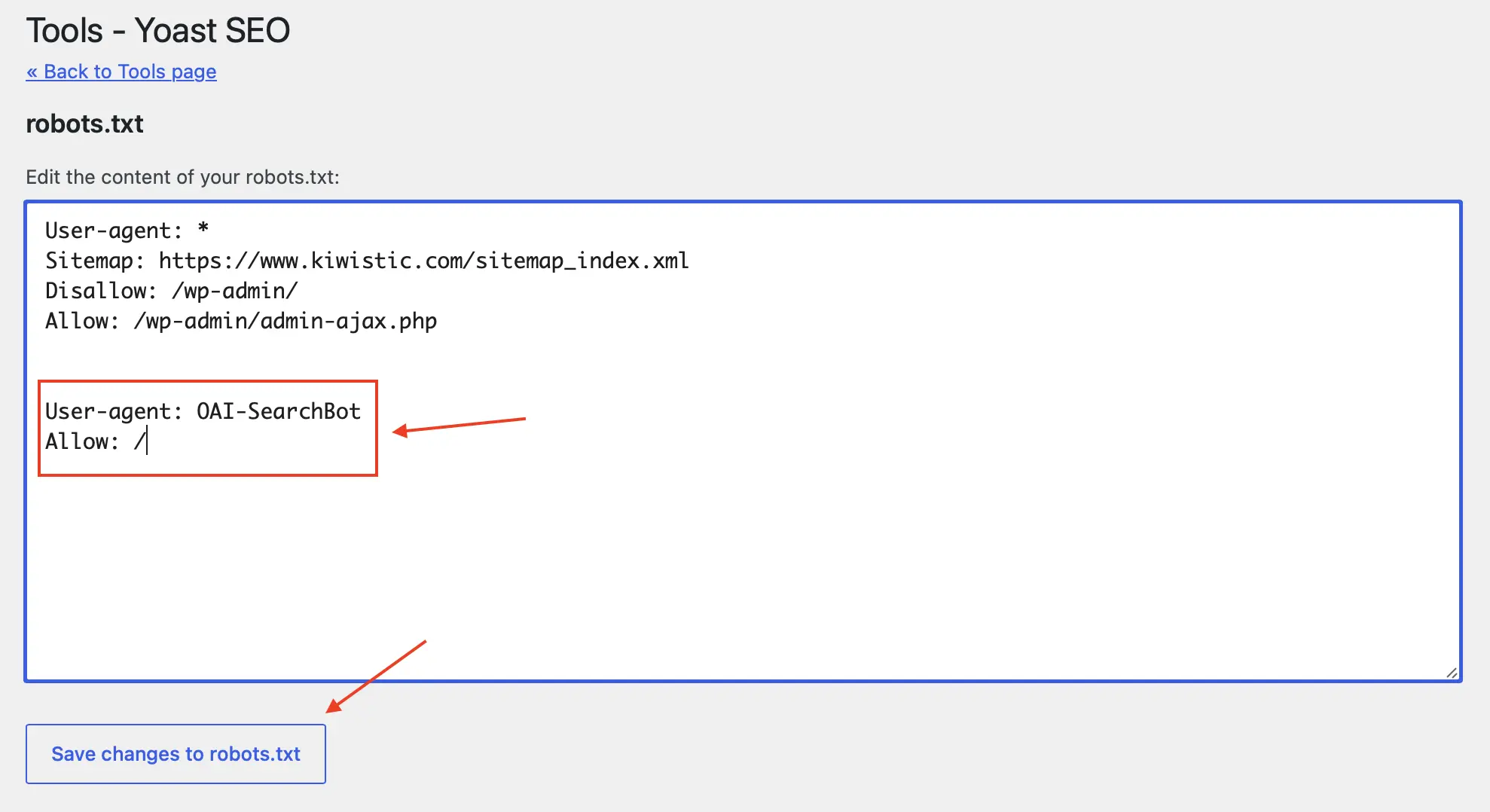
- Allow OpenAI’s crawler access to your site by including the following line in your
robots.txtfile:
User-agent: OAI-SearchBot Allow: /
- Inside your WordPress dashboard, go to YOAST SEO > Tools

- And Inside Tools, you will see File editor link. Go ahead and click on the File editor.

- Copy ‘User-agent’ from OpenAI Bots Documentation and past it here. Click Save changes to robot.txt button
3. Generate an XML Sitemap
- Use plugins like Yoast SEO or Rank Math to automatically generate an XML sitemap.
- OpenAI doesn’t currently offer a submission portal for sitemaps the way Google Search Console does. Instead, make sure your sitemap URL is referenced inside your
robots.txtfile, so OAI-SearchBot can discover and crawl it automatically.
4. Implement Schema Markup
- Add structured data to your website using JSON-LD or schema plugins to help ChatGPT understand your content better. If you’d rather have it done right the first time, our team builds custom schema markup as part of every WordPress development project.
5. Monitor Crawler Activity
- Use tools like Google Search Console or log analysis to ensure ChatGPT is crawling your site effectively.
Enhancing Your WordPress Website for AI Readability
Optimize Content for Natural Language Processing (NLP)
- Uses conversational language.
- Answers potential questions users might ask.
- Includes long-tail keywords naturally.
Write in a Way AI Can Quote
ChatGPT tends to pull short, self-contained sentences when it summarizes a page. Structure your key points as standalone statements that make sense even out of context — a sentence like “WordPress powers over 43% of websites” is easy for AI to lift and cite, while a sentence that depends on the paragraph before it usually gets skipped.
- Keep sentences under 20 words where possible.
- Answer one clear question per paragraph instead of blending multiple ideas.