Home / WordPress Guides / Plugins & Themes / Best Call-to-Action Plugins to Improve Your WordPress Site

Best Call-to-Action Plugins to Improve Your WordPress Site

TABLE OF CONTENTS

Free WordPress Site Review

Is your WordPress setup ready for what 2026 demands?

TL;DR

  • A CTA plugin adds popups, notification bars, slide-ins, or floating buttons to WordPress without code.
  • Top picks: OptinMonster and Thrive Leads for advanced targeting, Icegram and ConvertForce to start free, WPForms for form CTAs, Buttonizer for floating buttons.
  • Choose by goal, mobile experience, speed impact, and theme compatibility. Test on a staging site first.
Most visitors read your page and leave. No signup, no click, no message. A clear call-to-action (CTA) turns that quiet exit into a next step.
WordPress makes this easy, because you don’t need to code to add one. A CTA plugin puts popups, notification bars, slide-ins, and floating buttons exactly where visitors need them.
The hard part is choosing. Some plugins are packed with targeting rules. Others are light and simple. A few slow your site down or get in the way on mobile, which can cost you more than they earn.

This guide compares the best call-to-action plugins for WordPress: OptinMonster, Thrive Leads, ConvertForce, Icegram, WPForms, and Buttonizer. You’ll see what each does well, who it fits, and how to pick without guessing.

Why Call-to-Action Plugins Matter for WordPress

A CTA plugin does three jobs: it captures leads, it guides visitors, and it shapes the experience that search engines care about. Here is how each one works.

They Turn Traffic Into Leads and Sales

Traffic alone doesn’t pay the bills. A CTA gives visitors a clear next step, whether that’s joining a newsletter, downloading a guide, or requesting a quote.
Plugins like OptinMonster and WPForms let you add popups, slide-ins, or forms at the moment a visitor is most likely to act.
Best Call-to-Action Plugins for WordPress Site: Boost Conversions and Lead Generation

They Guide Visitors Through Your Site

A good CTA does more than collect emails. It points people to the page they were looking for, like a pricing page, a guide, or a booking form. That makes your site easier to use, which is a core part of user experience design.

Plugins like Thrive Leads add A/B testing, so you can see which CTA actually works instead of guessing.
Enhance User Engagement and Experience

They Support SEO, but Only When Used Carefully

Let’s clear something up: a CTA plugin won’t raise your rankings on its own. Google says page experience is not a single signal. Its core ranking systems look at many signals, and it recommends good Core Web Vitals.

What a plugin can do is protect or damage that experience. A well-timed CTA helps visitors find their next step. A popup that covers the main content on mobile does the opposite. Back in 2016, Google warned that pages where content is hard to reach after a mobile search may rank lower. Legal notices, like cookie banners, are treated differently.

The safe rule: don’t block the content the moment someone lands. Use small bars, slide-ins, or delayed popups that are easy to close.

Speed matters too. A plugin that loads heavy scripts can slow your pages, which is why we cover it in our WordPress website optimization guide.

Key Features to Look for in a Call-to-Action Plugin

Feature lists all look alike, so focus on the five that change results: design control, mobile behavior, setup, analytics, and speed. Miss one, and even a plugin that looks great on paper can underperform on your site.

Customization and Design Options

Your CTA should stand out without looking like it came from another website. Plugins like OptinMonster and Thrive Leads include templates you can adapt to your brand.

Check that you can control:
  • Colors and fonts to match your site’s style.
  • Size and positioning so the CTA is visible without being overwhelming.
  • Animations and effects to draw attention. Use them sparingly.
A CTA that looks like part of your site feels more trustworthy, and trust is what gets the click.

Mobile Responsiveness

Many visitors will meet your CTA on a phone first. Look for mobile responsiveness built in, so buttons and popups resize on their own. WPForms, for example, adjusts forms to small screens without extra work.

Then test it yourself. Open a live campaign on a real phone and check two things: is it easy to close, and does it leave the main content readable?

Easy Integration and Setup

Most WordPress users aren’t developers, so ease of use matters. Buttonizer and Icegram offer drag-and-drop setup. ConvertForce takes another route: you build CTAs with the block editor you already use for posts and pages.

Easy setup also makes it faster to test designs and fix mistakes. A good plugin should:
  • Install and set up in minutes.
  • Connect to tools you already use, like email marketing software.
  • Have a clear dashboard for quick edits and updates.

Analytics and A/B Testing

You can’t improve what you don’t measure. Plugins like OptinMonster offer A/B testing, so you can compare two versions of a CTA and see which gets more clicks. Change one element at a time: the text, the color, or the placement.
Built-in analytics should show, at minimum, how many people saw a CTA, how many clicked, and the conversion rate. If you use Google Analytics, check that the plugin can send its data there.

Speed and Performance Impact

Every CTA plugin adds code to your pages. Before you commit, run your key pages through PageSpeed Insights with the plugin on and off, and compare the results.

Look for plugins that load their scripts only where a campaign is shown. Lightweight, block-native tools like ConvertForce are built with this in mind. Larger suites may offer more targeting, so weigh what you gain against what they add to your page.

With these five features in mind, the comparison below is easier to read.

Best Call-to-Action Plugins for WordPress

The right plugin depends on what you want your CTA to do. Some are built for lead capture, some for forms, and one for a single floating button. Here is a side-by-side look before we go through each one.
Plugin Best for Free version CTA types
OptinMonster Advanced targeting and lead generation No Popups, floating bars, slide-ins
Thrive Leads Lead capture with built-in A/B testing No Popups, forms, sticky ribbons
ConvertForce CTAs built in the block editor Yes (Pro adds more triggers) Notification bars, lightbox popups, slide-ins
Icegram Budget-friendly popups and bars Yes Popups, notification bars, opt-in forms
WPForms Form-based CTAs Yes (Lite) Subscription, contact, and survey forms
Buttonizer Floating action buttons Yes (Pro adds more) Sticky floating buttons

Plan details checked in September 2026. Vendors change plans and prices often, so confirm on each plugin’s site before you buy.

1. OptinMonster: Best for Advanced Targeting

OptinMonster is a lead generation tool with a WordPress plugin. You build campaigns in the OptinMonster app, and the plugin connects them to your site. It offers popups, floating bars, and slide-ins to capture your visitors’ attention.
Its strength is targeting. You can show a CTA to specific visitors based on their behavior, location, or how long they’ve been on your site.
Best Exit-Intent Plugins for WordPress: OptinMonster Plugin

Key Features:

  • Drag-and-drop campaign builder.
  • Advanced targeting and segmentation.
  • A/B testing (on higher plans).
  • Exit-intent technology (on higher plans).
OptinMonster suits site owners who want a comprehensive tool and are happy to pay for it. There is no free plan, so check which plan includes the features you need before you commit.

2. Thrive Leads: Best for Lead Capture With A/B Testing

Thrive Leads is a paid lead generation plugin built only for WordPress. It lets you create forms, popups, and sticky ribbons, while tracking conversions with clear reports and analytics.
It also has built-in A/B testing, so you can compare two versions of a CTA and keep the one that converts better.
Thrive Leads Plugin

Key Features:

  • Advanced form builder with customizable templates.
  • Targeting and trigger options based on user actions.
  • Built-in A/B testing.
  • Integration with email marketing tools.
Thrive Leads fits WordPress site owners who want to grow an email list and are comfortable with a paid license. There is no free version, and it is often sold as part of a larger Thrive bundle, so check current licensing on their site.

3. ConvertForce: Best for Block Editor CTAs

ConvertForce is a call-to-action plugin built natively for the WordPress block editor. Instead of asking you to learn a separate drag-and-drop builder, it lets you design your CTAs with the same blocks you already use to write posts and pages, so buttons, headings, images, and even blocks from other plugins can go straight into a campaign.

You can display those CTAs in three ways: a notification bar at the top or bottom of the screen, a lightbox popup, or a slide-in that appears in a corner. ConvertForce is also built to stay light, with a small footprint that keeps it out of the way of your page speed, which matters if you plan to run CTAs across your whole site.
ConvertForce Call-to-action plugin

Key Features:

  • Three CTA types: notification bar, lightbox popup, and slide-in.
  • Built with the native WordPress block editor, so there is no new builder to learn.
  • Pre-built patterns for sales, announcements, and support CTAs.
  • Exit intent, scroll depth, and inactivity triggers in ConvertForce Pro.
ConvertForce is a strong pick for WordPress users who want fast, block-editor-friendly CTAs without adding heavy code to their site.

4. Icegram: Best for Budget-Friendly Popups and Bars

Icegram has a free version that helps you create CTAs such as popups, notification bars, and opt-in forms. It comes with a range of design templates and customization options.
That makes it simple to engage visitors and prompt them to act. It also supports exit-intent popups to capture leads before they leave, though which features you get depends on the plan.
Icegram-plugin

Key Features:

  • Multiple CTA options, including popups, header bars, and sidebars.
  • Easy setup with pre-designed themes.
  • Beginner-friendly interface, no coding required.
  • Exit-intent triggers (feature availability varies by plan).
Icegram is a good fit for site owners who want to start free and have a wide range of engagement features to grow into.

5. WPForms: Best for Form-Based CTAs

WPForms is a beginner-friendly form builder with a free Lite version. It isn’t a popup tool, but it works well when your CTA is a form: a newsletter signup, a quote request, or a short survey.
Its drag-and-drop builder and ready-made templates let you set up a form in minutes.
WPForms Survey Plugin

Key Features:

  • Drag-and-drop form builder with easy customization.
  • Pre-built form templates for fast setup.
  • Mobile-responsive forms.
  • Payment gateway integrations for online stores (paid plans).
WPForms suits site owners who want a CTA built around a form. If you need popups or slide-ins, pair it with another plugin from this list.

6. Buttonizer: Best for Floating Action Buttons
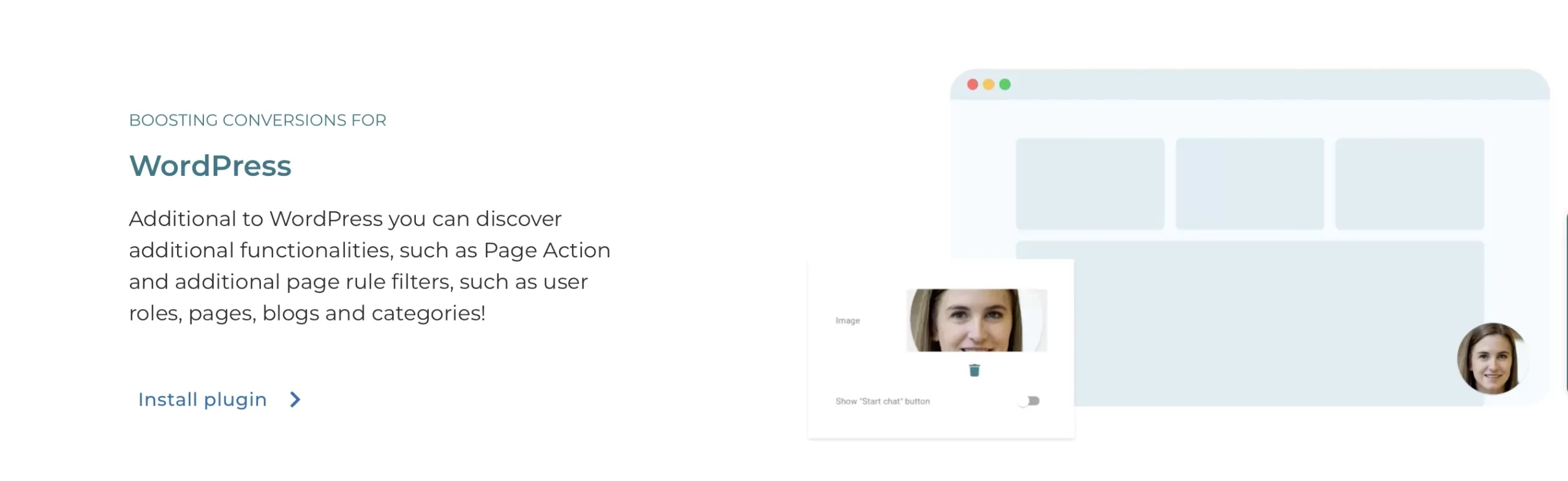
Buttonizer adds sticky floating buttons to your WordPress site. A button can prompt visitors to call you, start a chat, send an email, or jump to an important page, and it stays in view as they scroll.
There is a free version, and the Pro version adds more advanced features.
Best Call-to-Action Plugins for WordPress Site: Buttonizer
Key Features:
  • Floating buttons for actions like calling, chatting, or linking to a page.
  • Display rules by page, device, and time of day.
  • Triggers such as time on page, scroll depth, and exit intent.
  • Google Analytics event tracking, so you can see which buttons get clicked.
Buttonizer is a great option if you want a CTA that stays visible as people scroll, especially on mobile, where a “Call us” button can do more than a popup.

Adding a plugin? Keep the rest of your site steady.

Every new plugin adds code, updates, and one more thing that can conflict. Our WordPress care plans handle updates, backups, and security checks, so plugin changes are easier to manage.

How to Choose the Right CTA Plugin for Your WordPress Site

With this many options, the fastest way to choose is to work backwards from what you need. Use the five features above as your checklist, then narrow the list with the steps below.

Decide Whether You Need a Plugin at All

If you need one button on one page, your theme or the block editor can do the job, and you avoid adding code to every page.
A plugin earns its place when you need triggers, targeting, testing, or reporting. Start there. Fewer plugins also means fewer updates to manage later.

Match the Plugin to Your Goal

Your main goal narrows the list faster than any feature comparison:
  • Grow an email list with precise targeting: OptinMonster or Thrive Leads.
  • Build CTAs inside the block editor with a light footprint: ConvertForce.
  • Start free and add features later: Icegram or ConvertForce.
  • Collect inquiries, quotes, or survey answers: WPForms.
  • Keep a “Call us” or chat button always visible: Buttonizer.
Start with one goal. You can always add a second plugin later.

Check Compatibility With Your Theme and Editor

Make sure the plugin works with the way your site is built. Some tools are designed around the block editor, others use their own builder or an external app, and page builders like Divi or Elementor can behave differently with each. Check the plugin’s documentation for your setup before you install.
Also look for conflicts with plugins you already run, especially caching, cookie consent, and form plugins. When a popup shows twice or never shows at all, a conflict is often the cause.

Compare Cost and Licensing

Price is more than a number on a pricing page. Check whether there is a free version, what the paid plan adds, how many sites one license covers, and what renewal costs.
Some tools, like OptinMonster, run campaigns through an external app and bill by plan. Others, like Thrive Leads, are sold as licenses. If you manage more than one website, cost per site matters as much as the sticker price.

Test Before You Go Live

Never install a new plugin straight on your live site. Try it on a staging site first. Then open your campaign on a real phone, make sure it’s easy to close, and re-run your speed test.

If a plugin conflicts with your setup, or you’d rather not manage updates yourself, this is the kind of upkeep our WordPress maintenance plans cover.

Best Practices for Using Call-to-Action Plugins

A good plugin won’t fix a weak CTA. These six habits make the difference between a CTA that gets clicked and one that gets ignored.

Keep the Message Clear and the Design Simple

Your CTA should say one thing, in as few words as possible. Start with a verb and name the result: “Get Your Free Quote” says more than “Submit.” “Download the Checklist” beats “Click Here.”
Then make it easy to see. Use a color that contrasts with the page, enough white space around it, and text large enough to read on a phone. If visitors have to search for your CTA, the design is working against you.

Place CTAs Where Visitors Are Ready to Act

A CTA works best right after you’ve given the reader a reason to act. Good spots include:
  • Near the top of the page: for visitors who already know what they want.
  • At the end of a blog post: a natural next step once the reader has finished.
  • Inside the content: next to the paragraph that makes the case for it.
  • In a slide-in or bar: for offers that can wait until the visitor has scrolled or stayed a while.

Time Popups Carefully

A popup that appears the second a page loads interrupts before you’ve earned attention. Delay it, or trigger it after a scroll or a set time on the page.
Keep it easy to close, and don’t let it cover the main content on mobile. This is the interstitial issue we covered earlier, and it matters most on small screens. If you need a full-screen message, save it for a moment when the visitor has already finished reading.

Test One Change at a Time

If you change the text, color, and placement together, you won’t know what worked. Change one thing, run both versions to the same audience, and keep the winner.
Let the test run long enough to collect a meaningful number of visits, and decide on your goal before you start: clicks, signups, or completed forms. Then check that the results also show up in your analytics, not just inside the plugin.

Respect Privacy and Consent

If your CTA collects an email address, say what people will get and how often. If you serve visitors in the EU, marketing emails generally require clear consent, and cookie or consent banners need to work alongside your popups, not fight them.

Link to your privacy policy near the form, and check the rules for the regions you serve. This isn’t legal advice, but a clear, honest form also builds trust and tends to convert better.

Limit Each Page to One Main Goal

Too many CTAs make visitors freeze. Pick one main action per page and let everything else support it. A blog post might use one banner and one end-of-post form, not five popups.
If you’re adding a second plugin for a second goal, ask whether it’s really needed. Every extra plugin adds code, updates, and another thing that can conflict.

Conclusion

The best call-to-action plugins share one trait: they make the next step obvious without getting in the visitor’s way. OptinMonster and Thrive Leads suit advanced lead capture. ConvertForce and Icegram are easy places to start for free. WPForms handles form-based CTAs, and Buttonizer keeps one key action in view.
Whichever you pick, the plugin is only part of the result. Choose for your goal, test on staging, keep popups from covering content on mobile, and change one thing at a time when you test.

Want a second pair of eyes on how your CTAs, plugins, and site speed work together? Get a Free Site Review and we’ll show you what’s worth fixing first.

FAQ

What is a call-to-action plugin in WordPress?

A call-to-action plugin is a WordPress tool that adds popups, notification bars, slide-ins, forms, or floating buttons to your site. It helps you guide visitors toward one specific step, such as subscribing, booking, or buying, and most plugins let you set where, when, and to whom each CTA appears without writing code.

What is the best call-to-action plugin for WordPress?

There is no single best one. OptinMonster and Thrive Leads suit advanced targeting and A/B testing, ConvertForce and Icegram are easy to start with for free, WPForms fits form-based CTAs, and Buttonizer suits floating buttons. Choose based on your main goal, your editor or theme, and how much you want to spend.

Are there free call-to-action plugins for WordPress?

Yes. ConvertForce, Icegram, WPForms (Lite), and Buttonizer all offer free versions, though some advanced features sit behind paid plans. OptinMonster and Thrive Leads are paid only. Before you install, check which triggers and features are included in the free plan so you know what you can actually use.

Do call-to-action plugins hurt SEO or site speed?

They can, if used badly. Heavy scripts can slow your pages, and popups that cover content on mobile can hurt page experience. Well-chosen plugins don’t have to. Pick a lightweight option, delay popups, keep them easy to close, and compare speed test results before and after.

Do I need a plugin to add a call-to-action in WordPress?

Not always. For a single button on a page, your theme or the block editor is enough. A plugin makes sense when you need triggers like exit intent or scroll depth, targeting by page or visitor, A/B testing, or reporting. Start with what you’ll actually use, since every plugin adds code and updates.

Can I use a CTA plugin with page builders like Divi?

Often yes, but it depends on the plugin. Some are built around the block editor, others use their own builder or an external app. Check the plugin’s documentation for your builder, and test on a staging site before going live to catch display or conflict issues.


How many calls-to-action should a page have?

Aim for one main goal per page. A blog post might use one in-content banner and one end-of-post form. Too many CTAs compete for attention and can overwhelm visitors on mobile. If you’re adding a second popup or bar, ask whether it supports the same goal or distracts from it.

Ognjen Velickovic

WordPress Developer & Product Manager at Kiwistic. I build and maintain WordPress sites for small businesses and troubleshoot everything from login lockouts to security issues. These guides come from real experience, so you don't have to figure it out alone.

You May Also Like…